Monday, July 27, 2009

The Slippery Slope

*


A lesson, a gesture, a story, a philosophy, an attitude—I took something from every man in Steve's bar. I was a master at “identity theft” when that crime was more benign. I became sarcastic like Cager, melodramatic like Uncle Charlie, a roughneck like Joey D. I strived to be solid like Bob the Cop, cool like Colt, and to rationalize my rage by telling myself that it was no worse than the righteous wrath of Smelly. Eventually I applied the mimicry I'd learned at Dickens to those I met outside the bar—friends, lovers, parents, bosses, even strangers. The bar fostered in me the habit of turning each person who crossed my path into a mentor, or a character, and I credit the bar, and blame it, for my becoming a reflection, or a refraction, of them all.

Every regular at Steve's bar was fond of metaphors. One old bourbon drinker told me that a man's life is all a matter of mountains and caves—mountains we must climb, caves where we hide when we can't face our mountains. For me the bar was both. My most luxuriant cave, my most perilous mountain. And its men, though cavemen at heart, were my Sherpas. I loved them, deeply, and I think they knew. Though they had experienced everything—war and love, fame and disgrace, wealth and ruin—I don't think they ever had a boy look at them with such shining, worshipful eyes. My devotion was something new to them, and I think it made them love me, in their way, which was why they kidnapped me when I was eleven. But now I can almost hear their voices. Whoa, kid, you're getting ahead of yourself.

J.R. Moehringer, The Tender Bar.


What shocked him was the degree of his own romanticisation of these people, many of them dead. "I've never known anyone who knows so many dead people as you," someone had said, and while it wasn't Rawanda, the lifestyle we had fallen into was dangerous indeed. Bruce, the tall gangly poet, was the first to go, and he could not drive past that street in Turramurra where Bruce's parent's lived without thinking of the cold sadness of that early loss. He had spent his childhood nights floating across the cold suburbs, billowing on the wind, peering down, lost and alone yet triumphant in his liberation. Then he had found a new band, the partying gang, and while Bruce's death should have served as a warning of more to come, nothing was going to stop them. The grand chaos of the era could be heard even in this remote place, the giant concerts of the Rolling Stones at Wembley Stadium somehow had their echoes here on the other side of the world; and later Lou Reed in New York would play out in our loungerooms, as we sat around in and endless daze, playing cards, dealing out the 500 pack time and time again.

He had been in love with Tim and Jan and the whole damn gang, their children, the motley crew, Ian Farr, John Bygate, Lyn Hapgood, Colin Griffith. Every last one of them was dead now. The wonderfully eccentric sight of off-her-trolley Lyn wheeling her pram about Paddington, stumbling out of Bygate's beautiful Paddington terrace to see the day. John Bygate was everything he had wanted to be: astonishingly handsome, fabulously out of it, a great record collection, an intellectual obscurity which shut out all the hoi palloi. They were different, their closed club, intellectual giants, creative originals. John was always scribbling obscure music notations on sheets of paper, and he took to doing the same, writing obscure, funereal melodies while struggling to understand first year philospohy. He wanted to be different. He wanted to be loyal to his band. He thought of them as the beginning and the end, the group who's partying ways would change the entire country with the brilliance of their artistic output.

He wrote and he wrote, sine qua sine, garbled Latin phrases, ancient, ethereal floating castles, the ground littered with the crunched glass of shattered syringes, black and white chequered floors, a spiritual, hallucinatory place open only to the terminally gifted. In 2009, a quarter of a century after Bygate had lived in the apartment in Moore Park Road they drove past, Karl looked out of the car window and picked out the terrace where he had lived with Ian Farr and John Bygate and the rest of them. For the first time he heard the story of how Karl had met Bygate. He had been looking for a card reader, a clairvoyant, in Paddington, and had knocked on the wrong door. Bygate had answered, the ever present glass of white wine in his hand. Come in, come in, he declared expansively, as if he had been expecting him. Karl tried to explain that he had knocked on the wrong door and was looking for someone else, but Bygate was having none of it. Soon enough they were sitting around the kitchen table smoking. Soon enough John was talking about getting some pills, he just needed a bit more money to pay for the script. Soon enough they were collecting a bottle of mandrax and were off their scones.

And that was how Karl came to know that crazy crazy gang. It was the early 80s and they were already on the slippery slope. By that time he had started work at the Sydney Morning Herald, and his life was changing as he entered the mainstream. Sometimes he would sit around the Moore Park flat, hanging out with the old gang, listening to the hysterical tales of the male prostitute who would wander in from upstairs, complaining about his work load. Or knock back the proposition that he would fill in for him on one of the jobs. These were different days. He was too old to sell the flesh; ashamed of his own past, keen to become a new, professional person. But he still liked the bohemian tales, as if these people were more genuine than most he met. And so he would sit there, listening to the tales of chaos and lack of money, of unfulfilled dreams. Bygate was already getting more and more obscure. Already it was such a contrast from the fabulous person he had known in his hey day, in the late 60s, when they first met at that wonderful sugar-daddy provided house in Elizabeth Street, Paddington.

His moisturised skin was already beginning to show the wear and tear of the alcoholic. The fabulous terrace was long gone; as was the sugar daddy. His boyfriend, that shocking junky Gary, later to father a child with Virginia Fay, was also gone; and somehow it was this last in a long line of losses which seemed to toss Bygate closer and closer to the cliff's edge. He reigned over the motley bohemian crew that infected Moore Park, like some ancient, eccentric aunt. He wished them all well. He mumbled incoherently. He still drank his white wine, but these days it came from a cask. He still scribbled notations on sheets of music, but these days no one really believed he was about to produce a new Australian masterpiece. Another bottle of mandrax would arrive, and yet again the gang would be stumbling about, losing it, wandering off to the pub and returning days later, slurring words, falling into each other, desperately out of it, desperately in love. Instead of this life, these days he got up and went to work each morning. His visits became less and less regular.

And finally he wandered off altogether. And Bygate took another step down the slippery slope, moving to Adelaide where it was cheaper to live on the dole. And finally dying of a brain haemorrage. He never got sober. He never turned back. Karl and he held the memory, but even that was becoming increasingly obscure as they themselves aged and all that remained of that strange time was the memories of two men in their 40s and 50s as they drove down a busy Sydney street.


THE BIGGER STORY:

http://news.bbc.co.uk/2/hi/business/8169869.stm

Top leaders of the US and China are meeting in Washington to discuss key economic and political differences.

President Obama said the relationship between the US and China would shape the 21st century and said the two shared a "mutual interest".

China has sent Vice Premier Wang Qishan and State Councillor Dai Bingguo.

The meeting, called the US-China Strategic and Economic Dialogue, is the first formal negotiation between the US and China since Mr Obama took office.

'Strong coordination'

The talks will cover a range of issues, including halting the spread of nuclear weapons in North Korea and Iran, and creating clean and secure energy sources.

But the main focus will be on working towards economic recovery.

"The current crisis has made it clear that the choices made within our borders reverberate across the global economy - and this is true not just of New York and Seattle, but Shanghai and Shenzhen as well," President Obama said at the start of the meeting.

"That is why we must remain committed to strong bilateral and multilateral coordination."

Vice Premier Wang also said it was a "critical moment" for the world economy as it moves out of crisis and towards recovery.

Treasury Secretary Timothy Geithner and Secretary of State Hillary Clinton co-host the talks.

http://www.theaustralian.news.com.au/story/0,25197,25843607-5017771,00.html

Michael Stutchbury

THE PM bags the deregulation of the past 25 years but claims he wants to boost productivity.

KEVIN Rudd's second long crisis essay continues to misdiagnose Australia's economic challenges as stemming from the failures of a "decade of neo-liberal free market fundamentalism". And, compared to the first essay penned in January, an emboldened Prime Minister now feels vindicated that massive government intervention has saved global capitalism. But these intellectual foundations muddy rather than clarify the PM's reform principles for driving the next decade of productivity growth. His road to recovery ends up in the hoary political refuge of "nation building", which will also serves to justify post-crisis belt-tightening.

Rudd's straw man case against neo-liberalism is based on the historical fact that financial markets are vulnerable to herd-like swings between irrational exuberance and panic which, in this case, destabilised the global macro-economy.

Yet the intellectual critique of "behavioural economics" is better at poking holes in the "efficient markets hypothesis" that individuals act rationally than in demonstrating that governments know or can do better. In any case, this debate is largely confined to financial markets, not the whole sweep of pro-market economics. And it is largely a northern hemisphere argument, notwithstanding Rudd's efforts to lash the Howard-Turnbull Liberals to the supposed sins of "the right". A feature of the crisis is how well Australia's banking supervision has held up. The Reserve Bank has never been fundamentalist on financial markets, for instance supporting a floating dollar but also acknowledging that financial asset markets can "overshoot".

In a speech to the Sydney Institute last month, the federal Treasury's group director David Gruen outlined how mainstream macroeconomic theory had gone off course over the past few decades by incorporating the microeconomic assumption that financial markets were naturally self-correcting because well-informed individuals acted rationally in response to proper incentives. But Gruen pointedly added the following footnote: "In case I am being interpreted as pouring scorn on the benefits of more deregulated markets generally as opposed to financial markets in particular, let me dissuade you from that view.

http://www.theaustralian.news.com.au/story/0,25197,25843727-20261,00.html

Rudd addresses the Labor Party in Hobart on Saturday on the reception his essays received in these pages

TODAY, you might have read an essay that I published in the national press that looks beyond the immediate response to the global recession towards the challenges of economic recovery.

I've noticed that some don't particularly appreciate it when I write long essays.

http://www.theaustralian.news.com.au/story/0,25197,25843727-20261,00.html

After the publication of my last essay in The Monthly six months ago, I'm informed that one national newspaper published more than 50 separate articles attacking it in one way or another.

I'm also informed that's about 60,000 words the newspaper in question devoted to my mediocre prose.

Nearly 10 times the length of my original essay.

We should welcome a real debate about different ideas for the nation's future, including from newspapers that declare themselves unashamed defenders of the ideological Right.

Ross Gittins in The Age and The Sydney Morning Herald yesterday goes to war with occasional Fairfax contributor Kevin Rudd:

I'VE forced myself to read every bit of Kevin Rudd's latest 6100-word diatribe on economic recovery. Now I know what it must be like to sit through one of Fidel Castro's three-hour speeches.

It was a combination of the sensible and the self-serving, marred by its partisanship. Rudd nowhere acknowledges the role of his Liberal predecessors in pursuing the policies that left us so well placed in the global crisis.

He fails to admit that the relatively low and unconcerning levels of public debt in prospect are the product of his predecessors' budget surpluses and zero net debt.

The Libs also deserve credit for the good shape our banks are in. It was they who reformed our prudential supervision system, putting it in the hands of a single, well-armed regulator, and they who persisted with the Four Pillars policy that did so much to keep our banks out of trouble.

The notion that the Libs could be fairly described as "neo-liberal free-market fundamentalists" is laughable.

I'm starting to see the motive for all this "tough times" talk: you make it sound terrible so that, when it turns out it isn't so bad, voters are more relieved than angry.

It's spin, in other words.


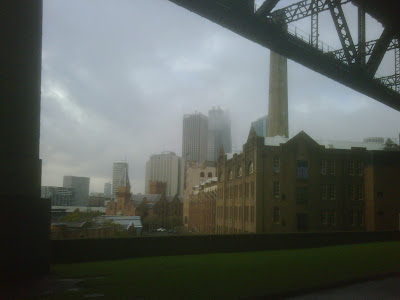
Redfern railway lines, Sydney, Australia.

Friday, July 24, 2009

Above The World

*


"We're in a bit of a pickle here, boy," Drew said. "Maybe you should stop drinking."
"Maybe you should start," Perry said. "I killed my best friend, cut off my own junk, and I'm some kind of psychic call-in line for these things. And you? Dude, you're dropping bombs in America. You're in charge of fighting honest-to-God aliens. Ask me, that's a pretty good reason for a snort or three."
Perry held out the bottle. Drew looked at the nasty scar on Perry's left forearm. War scars, that's what Perry had.
Drew accepted the bottle. The kid was right. Drew took a long swig. The bourbon tang was a welcome sensation, a friendly memory of distant times when he could just have a drink and relax. He knocked back another long pull...

Scott Sigler, Contagion.


Apart from some vague notion of the universe as an infinite and amazing place, like most people, he had no real knowledge or even desire for knowledge of God or a higher power or anything else in that domain. The purpose of recovery is to come to know the face of God, he read, and dismissed it as cultish nonsense. Children, they were virtually children, young things in their 20s, whined endlessly about their pseudo-difficulties and their love of "the program". He shuddered. It had come to this. And then they were gone. And people he had meant to confront, or just to talk to, were swept away in the crush. He wanted to go back to a time of innocent glory, to a time of powerful clairvoyance and an infinite ease with his own spirituality, when each night he went foraging across the suburbs of his early childhood, the cold crash of the surf in the early hours of the morning, the lonely twinkle of the street lamps, the deep cold of the houses nestled into the sides of the hills overlooking the beach. The deep green of the trees which were everywhere.

Nothing matched his inner dialogue. And so it was that he abandoned everything he had once stood for. Once he could hear them, the thoughts of others, as he sat on the bus on the long ride into town. Once, if he stared at people long enough, they would do what he wanted. Instead, now, his head was full of half finished stories, scenes which went nowhere, plots which dissolved before they had even formed. The old Eastern Europeans sat in the outback baths, the hot, sulphurous water giving off steam into the infinite night, the stars in the startling sky starting to come out as dusk deepened. They were large people, both the men and the women, plagued by health problems which probably directly related to their rich diets. There was no
English spoken. This land which had transformed utterly, from the ancient culture of the aborigines, living here for thousands of years, to the bustling technological world of the West, its architecture encrusted on to the ancient land, coating the hills and bays of the coast, spreading inland through the townships.

Prior to becoming a general news reporter on the Sydney Morning Herald in the 1980s his knowledge of the outback and rural Australia was limited to drug fueled spiritual quests against startling backdrops - from Ernabella, the aboriginal Jerusalem, where the sky itself turned pastel above the pastel red hills and yellow desert melons lay on the gorgeous pink sands to the rich farming country of the Liverpool Plains or the Hunter Valley, where the large, white well maintained fences of the horse studs bespoke a wealth he could only imagine. What had happened to that eccentric, wealthy older man in a flash sports car he had assumed was his destiny. He could see him, why not become him. Fragment Me Quick, Blue Queen, had been the science fiction novella he had written with a cast of himself and his friends, particularly Bill Rough. They had all been "creatives", as they were now called, and could see absolutely no other reason for being.

Last night he had driven back from Waverley down Moore Park Road, past the house where John Bygate and the wild crew he had known so well, had once considered the heart of everything, now lived. John Bygate was the star recruit. By this stage John was already in decay, the fabulous terrace in Elizabeth Street, Paddington, his sugar daddy had bought for him long gone. He had met John in the late 60s when Harry Godolphin, also dead, took him up from the Cross, where they would sit around all day on the musty straw floor coverings playing music and smoking bongs. He was a street kid and these people always liked to pick up street kids, foster their potential, maybe maybe not sleep with them. I'm the only one in your life who doesn't want to sleep with you, that's why you like coming here, Harry said, and it was probably true. Harry was the man he had met in a detox just after he turned 16. He hadn't stayed in the detox long; and having nowhere to sleep and sick of the hands of ancient men crawling across his body just because he needed a bed for the night.

He went back to Harry's place, the squat overlooking Woolloomoolloo, with its spectacular views and unique, aerie like location on top of the cliffs. None of those houses are there anymore, replaced by the famous now multi million dollar apartments along Victoria Street with some of the best views of Sydney anywhere. It was to Harry he told his initial dreams of maybe being a writer one day; a fantasy which seemed so impossible it would have been laughable. But Harry listened and encouraged him, the first adult to do so. And so he started scribbling things again, as he had done throughout his childhood, which had been littered with large literary projects he had thrown away after his suicide attempt. Harry gave him a sliver of acid and took him to see Hair and his world, his consciousness, changed forever. As did the rationals for his own behaviour. Far off, but suddenly not so far off, the Beatles and the Rolling Stones were playing giant arenas, and even here in this remote outpost of civilisation he could hear the drum beats of change. They were marked. They would always be defeated. But somehow, briefly, back there, before the impossibilities of life and love and success had destroyed him, he imagined a future full of hope and fun and achievement. How badly distorted things came to be.


THE BIGGER STORY:

http://www.telegraph.co.uk/news/worldnews/australiaandthepacific/australia/5900099/Muslim-woman-told-to-take-off-veil-by-bus-driver-in-Australia.html

Khadijah Ouararhni-Grech was wearing a pink, floral niqab, which covers her hair and lower face, when she tried to board a bus in Greystanes, an outer suburb of the Astralian city.

"As I was stepping onto the bus the driver said 'You can't get on the bus wearing your mask'," she told the Sydney Daily Telegraph newspaper.

When she explained it was religious dress, the woman said the driver responded: "Sorry, it's the law."

"I told him it wasn't the law and he said 'You have to show me your face,'" she said.

"I said to him, 'There's no difference between me and that lady sitting there who chooses to not wear what I'm wearing'."

The bus company, Hillsbus, said the driver was being questioned over the claims.

"We are investigating it and doing that as quickly as we can," a spokesman said. "We need to get to the bottom of it, work out what happened and what went on, and what we need to do about it."

http://www.abc.net.au/news/stories/2009/07/23/2634738.htm

Two more people have died from swine flu in Queensland, taking to five the number of swine flu-related deaths in the state.

Authorities have confirmed a 13-year-old boy died on the Sunshine Coast on Monday and an 84-year-old man died yesterday.

Queensland Health says both were classed as vulnerable due to existing medical conditions.

A 70-year-old man with swine flu died in Townsville Hospital yesterday.

Earlier this week, a 19-year-old woman from Palm Island lost her unborn baby through complications from the virus, while a 38-year-old woman died in Brisbane last Wednesday.

Muslims make up about 1.7 per cent of Australia's heavily Christian population of almost 22 million, and religious tensions have run high in recent years.

Anti-Muslim sentiment flared on Sydney's southern Cronulla Beach in December 2005 when mobs of whites attacked Lebanese Australians there in a bid to "reclaim the beach".

http://www.google.com/hostednews/afp/article/ALeqM5gS9Eg6gT_891qZQzJXIK49F6VEow

WASHINGTON — Iraqi Prime Minister Nuri al-Maliki paid symbolic tribute to US soldiers killed in Iraq, laying a wreath at the Tomb of the Unknown Soldier at Virginia's Arlington National Cemetery.

As the Iraqi and American national anthems played, Maliki paid his respects Thursday during a military ceremony of the type reserved for heads of state, which was punctuated by the firing of canons.

Maliki was joined by his delegation and Brigadier General Karl Horst, the commander of Joint Force Headquarters-National Capital Region.

The Iraqi leader observed a minute of silence, watched by a crowd of about 200 American tourists who were visiting the site -- a national landmark.

He did not make remarks at the ceremony.

According to cemetery officials, Thursday was the third time Maliki has visited the site to pay his respects, but the previous two visits were not open to the public.

An Iraqi official, speaking on condition of anonymity, said the trip was "very important to stipulate a new relationship after the withdrawal of the troops."

US troops pulled out of Iraqi cities at the end of June, as part of a bilateral agreement signed between the two countries.

The transition is a major step in the Iraqi government's attempts to assert its authority throughout the country, but questions remain about relations between the still-troubled nation's ethnic and religious sects.

The future of relations between the country's Sunni, Shiite and Kurdish populations was a topic in talks Maliki held in Washington on Wednesday with President Barack Obama.


Two in Advance

*


I used to say I'd found in Steve's bar the fathers I needed, but this wasn't quite right. At some point the bar itself became my father, its dozens of men melding into one enormous male eye looking over my shoulder, providing that needed alternative to my mother, that Y chromosome to her X. My mother didn't know she was competing with the men of the bar, and the men didn't know they were vying with her. They all assumed that they were on the same page, because they all shared one antiquated idea about manhood. My mother and the men believed that being a good man is an art, and being a bad man is a tragedy, for the world as much as for those who depend on the tragic man in question. Though my mother first introduced me to this idea, Steve's bar was where I saw its truth demonstrated daily. Steve's bar attracted all kinds of women, a stunning array, but as a boy I noticed only its improbable assortment of good and bad men. Wandering freely among this unlikely fraternity of alphas, listening to the stories of the soldiers and ballplayers, poets and cops, millionaires and bookies, actors and crooks who leaned nightly against Steve's bar, I heard them say again and again that the differences among them were great, but the reasons they had come to be so different were slight.

J.R. Moehringer, The Tender Bar.


Like watching paint dry, the meeting moved by so slowly. There had been books lying in boxes at the top of Wilson Street, past where he walked each day. He grabbed A Writer's Life by Jan Morris, a couple of volumes of Paul Auster, a couple of volumes from people he had never heard of. When did anyone get the time to read all these books anymore? When was salvation going to come? It didn't matter that whole junks of memory were going to disappear. He would still remember the rickshaws in Calcutta, dance in a for off, foreign field. The truth was that life as a professional in this God forsaken town was dull; you got up, you went to work, you followed the same snail trails every day, intersecting but never speaking with people doing the same thing. Crowded lives in a crowded city. Yet no one had reached out, he remained untouched. Opportunities came and went. They laughed, at him rather than with him. Oh please, please, release me from this bondage.

The distracted thoughts and crumbling buildings, he could not be held account anymore. Books were made to be finished. The shattered path, it was the only way. High in the clouds, the airships. Nicole at the helm. Spirit beings everywhere. The dark forces of the physical planet so far beneath them as to be of no account. Whistling high, with clouds for company. It was his destiny to float, and throughout his childhood he could barely wait to slip into unconsciousness in order to go flying, flying, high above the suburb, the control of his disembodied spirit a matter of mental tricks. He had been so long about the issue, long term narcotic use, that not even the sight of the skinny little aboriginal girls selling $20 packets of pot at the top of the Block, 150 yards from the police station, bothered him anymore. Did we have to get rid of all human influence in order to gain some level of purity? Of decent motive?

He wanted to go back to Calcutta, as part of his destiny, but was afraid of dying there. The magic kingdoms had all been in his imagination, or derived from books. He couldn't work out how to get back there. He couldn't work out how to gain his former mental powers. Life was cruel; he couldn't find what he was searching for. A way back to former gifts; including the power to fly, the way he used to wait until his parents had gone to bed, and then go floating. He knew the courts didn't want ordinary people in them, that the views of the masses were not welcome. The masses and the mandarins, indeed. The legal caste thought they had it all sewn up; simply be there soaking up the energy, relearning old mental tricks. How much he longed for a happy place; and could never be satisfied with the here and now. We all knew the story of the boy who had been forced to dig his own grave, down there in the National Park. All because he had crossed the wrong person, stolen off a criminal queen, just like they stole off every one. They weren't sophisticated enough to pick their targets, they just robbed everyone they slept with.

He was blubbering. He wanted the police to turn down the volume, to set down the law for the teenagers filling his house, four girls and climbing in the front room at last check. They were all escaping boarding school, and Henrietta had the cool dad who let them do what they wanted to do, make a bit of noise in the middle of the night, giggle a lot. Which was so innocuous in comparison to what he got up to at their age he let them go straight ahead. It was better than many of the things they could be doing, scoring on the corner, bongs, collective outrage. But where was that these days? There was no spirit of revolution. Australia had descended into being virtually a communist country, Who's the aboriginal in the family, someone asked, noticing the paintings. Suzy, the kids mother, she identifies, he replied. And back out there on the plains where they all came from, he could feel the ancestors calling. Come back, come back, we will envelop you with love.

But he wasn't ready to leave the physical world yet. There was too much work to be done. Books to be written. Thoughts to be stored. Are you happy? I don't care mate, survival is the key. The skinny little drug dealers followed his every move, keeping a beady eye out as he crossed the road. They lost interest when they saw the dog - and his grey hair. The bar was his refuge and his destroyer; like the character in The Tender Bar he had gone there so early, to the Rex. Kind of like it now, he had told the librarian, he wanted his own thoughts back. He had been the subject of identity theft yet again. I don't know who I am, I can't be seen to be making these same mistakes all over again. He was conscious of an altered planet, of lost opportunities, of a past so long ago his memories of those grand events was beginning to fade; those years he thought he would always remember, those moments high above the suburbs; a return to the form of 2006. They had been so utterly betrayed; but above all had betrayed themselves. The daily grinding routine, the gross physicality of his wretched body, he was going to climb back to his former clairvoyance; he was going to become the person he was always meant to be.


THE BIGGER STORY:

http://www.abc.net.au/news/stories/2009/07/24/2635902.htm?section=australia

Police investigating the murder of a Sydney family say post-mortem examinations on the five victims have given them valuable information but it will be weeks before the results of some forensic tests are known.

Forty-three-year-old Min Lin, his wife, two sons and his sister-in-law were bludgeoned to death in the family's North Epping home, in Sydney's north west, last weekend.

Detective Inspector Geoff Beresford says police have now spoken to all the family members in Sydney, including relatives visiting from China.

He says toxicology tests from the post-mortems will not be available for some time but he is confident a suspect will be identified.

"I am as confident as I have been throughout this week, I am very pleased with the progress so far as the forensic results that are coming in," he said.

"But again I repeat there's an enormous amount of work to be done, it's not a process that can be hurried, nor will it be hurried.

http://www.smh.com.au/environment/expect-more-blowups-before-november-20090724-dw68.html

THE ink was barely dry on Malcolm Turnbull's press release yesterday when Wilson Tuckey was out slamming the new offer as a time-buying exercise cooked up by the arrogant leader and his "sycophantic" shadow cabinet.

Safe to say, therefore, that Turnbull and senior Liberals have given up on wooing Tuckey and his band of supporters - not to mention the Nationals - as they sort out the climate dilemma.

Turnbull and Co are prepared to negotiate on the basis of being able deliver a majority view inside the Liberal Party, not a unanimous one. They - at least, for now - have a position by which they can stand and all sound like they are saying the same thing. After this week, that is an achievement.

The nine amendments devised by the shadow cabinet will not be accepted by the Government before August 13, when the vote is scheduled, if at all.

Penny Wong suggested cheekily she would consider them "once Mr Turnbull has agreed amendments with his party".

In this sense, it does buy time because the Coalition will, as one, vote down the scheme next month.

But afterwards, unless the Government folds and accepts them, or the Coalition blinks and softens its demands, we are none the wiser as to what may happen the second time around in November when the Government reintroduces the bill as a double dissolution trigger.

One gets the feeling there will be more blow-ups between now and then.

Mr Turnbull's personal support in Newspoll has recently taken the biggest plunge of any opposition leader and his position has been described as "terminal" by some Liberal MPs, although there is no-one to replace him.

Mr Abbott, who is releasing his own book next week on conservative politics, is not regarded as a leadership candidate in the short term and he has been strongly aiding Mr Turnbull in parliament when the Liberals have been under pressure.

"Opposing the legislation in the Senate could ultimately make poor policy even worse because the government could negotiate a deal with the Greens," Mr Abbott says in an article published in The Australian today.

"Alternatively, after several months in which political debate focuses on climate change and opposition obstructionism, the government could call a double-dissolution election on the issue of who's fair dinkum about trying to save the planet."

http://www.theaustralian.news.com.au/story/0,25197,25826885-601,00.html

Mr Turnbull was attacked from within his own party this week when he suggested overturning the Coalition's current position on emissions trading and agreeing to pass the scheme with business-friendly amendments.
Liberal backbencher Wilson Tuckey accused his leader of arrogance and inexperience in contradicting the Coalition position, sparking an internal party battle. Mr Tuckey also suggested Mr Turnbull was scared of facing a double-dissolution election over the issue.

But Mr Abbott said Mr Turnbull was being "far from arrogant" and knew "voters are unlikely to be argued into changing their minds" on an ETS.

"Oppositions, after all, can't save the country from the wrong side of the parliament and can't be expected to protect people from the consequences of changing government," he said. "It will be the cost and complexity of emissions trading and the absence of anything much out of the ordinary about climate that will slowly engender second thoughts."

Mr Abbott also said the Coalition was in a political bind climate change. "The problem, at least for politicians who prefer rational debate to following fads, is the public's current perception that climate change is uniquely dangerous and particularly associated with man-made carbon dioxide emissions," he said.

The Betrayal Of Ancient Dysfunction: Finding A Story To Fit

*


Everyone has a holy place, a refuge, where their heart is purer, their mind clearer, where they feel closer to God or love or truth or whatever it is they happen to worship. For better or worse my holy place was Steve's bar. And because I found it in my youth, the bar was that much more sacred, its image clouded by that special reverence children accord those places where they feel safe. Others might feel this way about a classroom or playground, a theater or church, a laboratory or library or stadium. Even a home. But none of these places claimed me. We exalt what is at hand. Had I grown up beside a river or an ocean, some natural avenue of self-discovery and escape, I might have mythologized it. Instead I grew up 142 steps from a glorious old American tavern, and that has made all the difference.

I didn't spend every waking minute in the bar. I went into the world, worked and failed, fell in love, played the fool, had my heart broken and my threshold tested. But because of Steve's bar each rite of passage felt linked to the last, and the next, as did each person I met. For the first twenty-five years of my life everyone I knew either sent me to the bar, drove me to the bar, accompanied me to the bar, rescued me from the bar, or was in the bar when I arrived, as if waiting for me since the day I was born.

J.R. Moehringer The Tender Bar.


The urgency of unfinished projects now overwhelmed him. History had a habit of repeating its own mistakes. Only he could stop this. Only he could stand up against the inevitable tide of facism. Of hysterical anti-male anti-family rhetoric which was consuming the everyday, so that Orwell's 1984 was doomed to repeat time and again. He couldn't have been less worthy. Rarely sober, much of his life had disappeared in an internal looking cloud, the fussing and fiddling of the masses not even of interest in a cloaked and muffled world where the cushioned sounds of falling leaves in a vacuum was all that he had ever known. The vast gaps. He didn't know who he was anymore. He hadn't made up a story to suit the moment. He hadn't donned a mask which would reflect well, or create attention, or divert the ill wishers. He hadn't been born again, yet, and as a malformed, splintered, half sprung creature he could not grasp what was happening to him, or why they felt so injured by a past which was so long ago.

I was a boy from the suburbs and I, too, thought I had arrived in paradise when I landed in the Cross, when there were stories of the dead who did not obey, of bouncers who killed people, gangsters who made their toy boys dig their own graves in the National Park south of the city, when terrified children shook in the wet dewy dawns, the smell of eucalyptus all around them, the shape of the grave taking place in front of them. It was hard to separate fact from fiction anymore. The things which had meant so much to him were nothing to anyone else, there were no reference points, no common knowledge. It's interesting to hear about all that stuff, the man said, when the subject of the Rex Hotel and the Bottom's Up bar came up, and damaged souls in adult male bodies looked back and felt sorry for the adolescents they had once been.

He looked back and felt pity, but having never communicated what really happened, and having been pissed as a newt for most of it, he was not so damaged as he might have liked to have been. Instead he had regarded it all as a great adventure - something to be, something to say you had been. Something which marked him as an adventurer, as someone different from the dreary, blank, unresponsive masses of the suburb from which he came. They marched in cardres, like mini-soldiers, in their cold uniforms in the midst of winter. They never ventured to be different, for to be different was to be singled out and ridiculed. And of course caned by the teachers or beaten at home. So he settled behind the conformist mask, shivered in the cold in their neat, grey shorts, and prayed for relief. This couldn't be all there is. Surely he wasn't expected to stand on his own two feet, to defy rescue, to grow up?

But of course that was exactly what life demanded. He had always wanted to be rescued, for someone else to look after him; and in those early yeears the sugar daddies had queued up to perform the role. Now, a man in his 50s, the whole adventure lacked glamour; a man with grey hair telling a story from long ago. Decades after anyone had fancied him, or paid to see him take his clothes off. Damp with excitement. He always insisted there was a bottle of whisky in the hotel room when he arrived, it was part of the deal. And, already drunk from the bar, he would proceed to demolish the whisky so that when the fateful moment came and he was expected to join the client in the bed, he was so sloshed he had no idea what he was doing, and lay there while they worked away at his young flesh. Give as little as possible, get out as soon as you can, always, always, make sure they pay for it. The attitude was not professional.

While he had met professional workers since, perhaps even paid for their services on the rare occasion, that was not his story. And so the deep hurts of a fragmented childhood continued drifting to the surface; and he shrugged, there were lots worse stories than his. He felt like exaggerating, to make more readable the tragic tale of his isolation, the brutality, the bruises, the belts, the horrific beltings he endured on a daily basis. There was no need to exaggerate; and yet he felt like lying on the ground and kicking and screaming, look at me, look at me, look at what you have done, they have done, the world has done, bastards. No one could care less. These crimes against nature were committed long ago. If he was to find salvation, it was not going to be in memory, or even in story telling. It was in reaching out to other human beings, picking up the phone, being a decent friend. The isolation which had haunted his every waking moment, the dysfunction and overwhelming despair which had crippled his every action and so severely distorted his public persona, all of it was about to fade as he became busier than he had ever been. There was much to do, and little time in which to do it.


THE BIGGER STORY:

http://www.timesonline.co.uk/tol/news/politics/article6726147.ece

Parliament's youngest MP was today chosen by voters to represent Norwich North after support for Labour plunged in the first by-election since the MPs expenses scandal.

The Conservative, Chloë Smith, 27, won a bigger than expected 7,348 majority, overturning Labour's lead of 5,459 in the 2005 general election.

Labour was down 26.7 per cent on the general election, with 14,854 voters deserting the party since 2005. The turnout was 45.8 per cent amid suspicions the Labour vote failed to turn out.

The result will delight the Tories, who had been briefing they expected a majority of less than 4,000 as recently as Tuesday.

Ms Smith, a Deloitte consultant seconded to the Conservatives, will now take the crown of youngest MP from Jo Swinson, the 29-year old Liberal Democrat.

Ms Smith said that this has been victory for "honest politics".

"They have voted for change and sent a message for Gordon Brown," she told the count.

http://www.guardian.co.uk/politics/2009/jul/24/norwich-north-byelection-result

David Cameron has inflicted a humiliating byelection defeat on Gordon Brown as the Conservatives beat Labour into second place in Norwich North.

In the first electoral test since the MPs' expenses scandal rocked Westminster, the Tories' Chloe Smith won the Norfolk seat with a majority of 7,348 and, aged just 27, becomes the youngest MP in the Commons.

Labour's defeat, in a seat held comfortably by the party since 1997, is the fifth byelection blow Brown has suffered since he took over at No 10.

If the result was repeated across the country in a general election, the Tories would be swept to power with a Commons majority of 218, analysis by the Press Association news agency showed.

The Tories would have 434 MPs, with Labour on 107, the Liberal Democrats 79, and others 30.

Responding to the news, the prime minister admitted it was a disappointing result but said no party could take a "great deal of cheer" from it because all three of the main parties had lost votes.

http://www.abc.net.au/news/stories/2009/07/24/2636081.htm?section=business

Federal Opposition Leader Malcolm Turnbull has unveiled the details of a significant policy shift on the Government's emissions trading scheme.

The shadow cabinet held a phone hook-up this afternoon and has agreed to vote for the legislation this year if the Government agrees to a number of amendments.

All this is aimed at avoiding turning the legislation into a trigger for a double dissolution election.

But there is concern in both the Liberal and National parties at the untidiness of a week, which saw one MP calling Malcolm Turnbull arrogant and inexperienced.

As a staunch Catholic and one who once began training for the priesthood, Tony Abbott is obviously someone who believes in conversions.

Last year he championed the cause of three men: Brendan Nelson, Malcolm Turnbull and Peter Costello, all in the one week.

And now he has turned his talents to emissions trading.

In the last two months he has expressed wariness about an emissions trading scheme, calling it an expensive and futile gesture, and saying a straight carbon tax or charge would be more transparent.

But this morning he came on board Mr Turnbull's push for the Coalition to amend and then pass the Government's Carbon Pollution Reduction Scheme when it comes to a vote in the Senate, either the first due in August or the second due in November.

Mr Abbot says opposing it would set it up as a double dissolution election trigger and it is Mr Turnbull's assessment that it is a fight the Coalition can not win.


Tuesday, July 21, 2009

Rock Bottoms

*


Violent conflict, not confinded to the home and hearth, spills out onto the streets. Moreover, I discovered that British cities such as my own even had torture chambers: run not by the government, as in dictatorships, but by those representatives of slum enterprise, the drug dealers. Young men and women in debt to drug dealers are kidnapped, taken to the torture chambers, tied to beds, and beaten or whipped. Of compunction there is none - only a residual fear of going too far.

Perhaps the most alarming feature of this low-level but endemic evil, the one that brings it close to the conception of original sin, is that it is unforced and spontaneous. No one requires people to commit in. In the worst dictatorships, some of the evil that ordinary men and women do, they do out of fear of not committing it.

Theodore Dalrymple.


And so it goes, the time sequences, the flash floods, the aching hearts. If all was well he would not be here, in this place, begging forgiveness. He felt so ashamed of himself for having wasted so much of his life. He would have been an entirely different person, if only he had been cured. But that was not to be. Life was to pass by in clouds of pot smoke and drunken evenings at the pub. In a life entirely dedicated to pleasure. Except there was no pleasure at the end, only a sad old party animal with the faraway glaze of a distant criminal, not of this world. It had been hard to manufacture such profound thought disorder. It had costs thousands of dollars and hundreds of hours. And so when he came to partake of the real world, he was little fit. Richard would embrace him, almost as a lover, and when Stephen cracked the code we were all jealous, because we had all been in love. That drunken embrace. That devine energy. Those astonishing good looks.

And now he's dead and nothing but a memory; and few of us made it to what must have been the saddest of funerals. Why did he collapse so quickly into dereliction, living in his mother's large old house in North Adelaide, rarely going out. His father had been an academic of osme mysterious kind, everything we didn't understand was mysterious, the beauty of the Adelaide Hills and the abandoned network where we used to go to pick flowers to sell around the office blocks. There were always ways to make money, it just required enginuity. While his own teenagers lived off his efforts as if it was their God given right; and never even thought of contributing. No government helped him. No gratitude was forthcoming. Peter's voice still remained in his head, shrieking, loud, angry, impossibly camp; and his solution to ever problem: What Have YOU done about it?

Talking to him was like taking a cold shower, bracing, confronting, and often enough it was a managemnet issue, keeping him calm and the light sabres innocent. He was trying to grow, trying to avoid the consequences of his own dereliction. It was not to be. Failure was imminent. That's how he felt. That there was no way he could turn this old ship around. That momentary piece was just an illusion, recovery was an illusion, the long nights where he could barely sleep just an illusion of progress. He couldn't last much longer. Life, God, the universe, call it what you will, had only provided hope in small measure and he had betrayed all the rules of nature; and therefore could not survive. There was nothing to look forward to. Old age would not provide the peace he had long sought. Shadows flicked at his heels, the foundation core dissolved into shadows at the slightest exposure, and his desperate search for some structure in which to hide, or to build quickly enough a frame in which to live, had all been swept aside.

He didn't know what the answer was. He was convinced of his special destiny but had made too many mistakes, smoked too many cigarettes, slipped once too often, and the cnacer was eating out his lungs and his body was shutting down. Emphesema for sure. Hypochondriac, for sure. He could not believe his luck, that he was still alive. Hauled unconscious from swimming pools. Walking, emerging live from the beach, Newport beach, where he had walked along waiting for the tablets to take affect, waiting to die, the sound of the surf crashing on the yellow sands, the cliffs cold and remote. There was no one to talk to. He cried and went home, to be beaten again. And again. And he never said: you bastards, stop it, stop it, I've just tried to kill myself and here you are giving me another thrashing. You bastards. How could you treat your own child like this?

Clearly he was hated. Clearly there was nowhere to go. But then he discovered something, hitch hiking one day to shooting practice out at Narrabeen Lakes. He was the object of desire for a whole rnage of men, who thought there was nothing more exciting than a 14-year-old boy. He stuck out his thumb and they screached to a halt. They didn't have to hint very much for him to be readily available. They puffed and they panted and they licked, and all of a sudden he discovered a source of power and affection, even if fleeting. Later, when he turned 15, Old John Mason, a friend of his father's, would pull up beside him in his nice, low slung Jaguar. Want to get in he would ask. He always got in. They would go back to his house. If only his father knew. Then there'd be trouble. But he never told him, he never told anyone, he just started hitch hiking wherever he went.

If his home life was miserable, suddenly there was another world where he was the centre of attention, plied with alcohol and money and their dribbling hands, touching him, touching him, because they couldn't get enough. You're so beautiful, they would pant, and he let them do whatever they wanted. Which usually wasn't much, suck him off, stare at his young frame, and he looked young for his age, which perhaps made the crime even worse, although no one thought of it as a crime back then. It was just boys being boys in a subterranean world, where everything was illegal and the real world, the solid middle class world of morality and churches, the place where the belts kept sneaking out aqt him, a thankless, cruel and indiffernet place, was hidden and gone, unable to hurt him. Their hands spread all over him and he did whatever they asked, it was a mystery to him. He couldn't see what all the excitmenet was all about. Come quick, get it over with, I want the alcohol, was all he could think.


THE BIGGER STORY:

http://news.bbc.co.uk/2/hi/asia-pacific/8160341.stm

The Indonesian capital Jakarta is getting back to business after two US-owned luxury hotels were hit by twin bombs on Friday.

The attacks killed nine people and injured dozens more.

Police suspect they were the work of the Malaysian extremist Noordin Mohamed Top, believed to have links to the radical Islamist group Jemaah Islamiah.

Indonesia had been making progress against militants and held a peaceful presidential election earlier in July.

The streets of Jakarta were filled with the usual cacophony of cars, trucks and motorcycles.

People in the city were getting back to business - the first day back at work after the deadly attacks that took place last Friday.

The crowds that had gathered around the bombing site over the weekend and on Monday's holiday to pay their respects were slowly thinning out.

http://www.theaustralian.news.com.au/story/0,25197,25816069-601,00.html

A GROUP of Taliban suicide bombers have tried to storm government buildings and a military base in two cities in eastern Afghanistan killing four people.
Six suicide bombers, some of them also carrying guns, tried to enter several government buildings in Gardez but were shot dead before reaching their targets, Rohullah Samoon, a provincial government spokesman told AFP.

"One of the bombers detonated in front of the intelligence department killing three intelligence officers. The other bombers were killed by security forces," he added.

Two other bombers were killed in exchanges of fire with police in Jalalabad as they tried to fight their way into the city airport, a base for Afghan and foreign troops forces, said the relevant spokesman, Ahmad Zia Abdulzai.

He could not give more details but a doctor in the city's hospital told AFP that one dead policeman was brought to the hospital.

http://www.smh.com.au/environment/global-warming/rudd-picks-howard-minister-for-emissions-job-20090721-drij.html

Prime Minister Kevin Rudd has appointed former Coalition environment minister Robert Hill to head a key element of the Government's emissions trading scheme.

Mr Hill will chair the Australian Carbon Trust, a $75 million initiative that will promote energy efficiency in homes and small businesses, and allow individuals to feel they are making a difference by letting them buy carbon permits.

Mr Hill held the environment portfolio in the Howard government and his appointment has the potential to embarrass Malcolm Turnbull, also an environment minister under John Howard.

Mr Turnbull is grappling with trying to achieve a consensus in the Coalition on climate change.

The Senate is due to vote on August 13 on Labor's emissions trading scheme and the Coalition has agreed to vote the scheme down.

Killing Parking Cops

*


I had the choice to do something more pleasing if I had wished, and I was paid, if not munificently, at least adequately. I chose the disagreeable neighbourhood in which I practiced because, medically speaking, the poor are more interesting, at least to me, than the rich; their pathology is more florid, their need for attention greater. Their dilemmas, if cruder, seem to me more compelling, nearer to the fundamentals of human existence. No doubt I also felt my services would be more valuable there: in other words, that I had some kind of duty to perform. Perhaps for that reason, like the prisoner on his release, I feel I have paid my debt to society. Certainly the work has taken a toll on me, and it is time to do something else. Someone else can do battle with the metastasizing social pathology of Great Britain while I lead a life aesthetically more pleasing to me.

Theodore Dalrymple.


There were so many days flying by, he was shocked at the way his life had disappeared. Where were all the great works? Why had everything disappeared in clouds of smoke? Literally. From the grand days of the Aquarius Festival, when it felt as if the world was turning on its axis and he was at the centre of it, a part of a greater movement, sent by the Divine to record all that was, all that ever would be. Now he was a doddering old man with a limited life span. And everything was going down the chute. There wasn't enough time in one day to do everything he wanted. He walked and he walked: taking seriously the old maxim, if you can't talk it out walk it out. That was very important to him. There in the cold of the pre-dawn, on the mostly deserted streets, Major the dog scuttling along in front or behind him. He could feel them sleeping in their houses; and they would never know how he had lingered over them like some damp, evil spirit, watching jealously their simple physicality, their uncomplicated embrace of life.

He saw Don from the Kincumber Spiritual Retreat, all wound up, critical of the pack mentality of the group, running, clustering, in fields of gold, our spirits united across divine dysfunction, shadows and shallows and distorted hope. He was sure he was going to fail. Nothing made sense anymore. All the old dreams had vanished. He was fearful he had become one of those leached out people he had never wanted to be, those vacuums of charisma without ambition, without goals, seemingly without talents. What do you want to be? Nothing. Did you ever have any childhood dreams? No. Wasn't there anything you ever aspired to? No. They sat in their vacuums, their bodies giving off the smell of death even though they had recently washed, their hair still damp. Doesn't anything happen in that damned head of yours, he felt like shouting, standing up and stepping towards, strangling. You can't be that much of a dead head. You can't be so totally vacuous.

Get a proper job dog, he shouted at the parking cop, who had only just caught him after the malfunctioning metre ran out early. This was a disgrace; and they could never be wise. The tyranny of the parking police have destroyed Sydney as a reasonable place to live, wasted thousands of man hours as people are forced to move their cars constantly, and led to the employment of cadres of working stiffs, goons coating the streets, lurking around corners, watching every move of the populace, totalitarian in their instincts. While the left wing counsellors held extravagant lunches for themselves on the proceeds of ordinary working people who couldn't find somewhere to park. It was a disgusting disgrace getting worse as other sources of revenue for councils dried up. The tyranny became ever present. The only alternative public transport: crowded, dirty, full of the smells of the unwashed crushed together. Why was there no way out?

He took it personally, the destruction of the city he had once loved. He couldn't just go and visit a friend in Paddington without confronting a major drama about where to park, coins for the metres, constantly having to check his car. He would cheerfully have exterminated the parking police from the planet, just as sometimes he would have liked to have the power to make the traffic in front of him disappear, hundreds of people daily disappearing without explanation, their families, if they had families, searching for them fruitlessly. When the true story was they had vanished because they had got in his way; and his car drove down the highway making everybody in front of him disappear. How irresponsible. How fascistic. And yet the ever growing power of the state was already doing much the same, crushing the spirit of the populace. He couldn't resist. The fight was bigger than just one person.

That others didn't share his passions and hatreds he never understood. Why didn't everybody fantasise about killing parking police? Of obliterating them from the planet? Their very ordinariness was mirrored all around him, and he thought there were ways to cure what was clearly a costly disease, these people, totalitarian scum who had become the instruments of the state, did not deserve to exist. They could persecute others with impunity, clearly with no conscience. Their shackles, their controls, deserved to be cast off. They themselves deserved the most miserable of deaths. He saw the parking cop scuttling away from him as he approached his car, ashamed, as if the ticket he had left on his wind shield was really excrement. Get a proper job dog he shouted as loud as he could, startling the office workers queueing for a bus opposite. The inspector never looked up, scuttling away in embarrassment. Shouldn't he be the one embarrassed for going off like a chook in public? Not for one second. He ripped the ticket out from under his wind shield wiper, screwed it up and threw it on the ground in disgust, not even bothering to look at the amount. May ill health, tragedy and a terrible sadness follow you all the days of your life, he chanted in an evil incantation, aiming his hatred at the rapidly disappearing back of the parking cop. I don't understand why someone doesn't go around murdering them, he said, I'm sane and I hate them. The person he was talking to, a random walking past, raised a questioning eyebrow. He got in his car and drove off, gunning the engine to express annoyance. As if anyone, in this ruthless, totalitarian place, could care less how he felt.


THE BIGGER STORY:

http://news.bbc.co.uk/2/hi/south_asia/8159788.stm

Mohammad Ajmal Amir Qasab's confession took everyone by surprise - even his own legal team.

As news of his confession spread, the Mumbai courtroom became packed with reporters.

The shock came on Monday morning, when the court was in the process of recording evidence. The suspect told the judge he wanted to say something.

After speaking to his lawyer very briefly, Mr Qasab said: "I accept my guilt."

Judge M L Tahiliyani asked him to what was he pleading guilty. Mr Qasab admitted that he had carried out the firing at Mumbai's railway station in November 2008.

The judge then heard arguments from prosecution and defence lawyers over whether a confession could be recorded at this stage of the trial.

When it was noted by the court that he could indeed make the confession, Mr Qasab proceeded to give a detailed account of how he and nine others came to Mumbai from Karachi last November, and the training that led up to it.

Speaking for several hours, he first described what happened when he and accomplice Abu Ismail entered the Chhatrapati Shivaji Terminus (CST) railway station.

"In CST, Abu Ismail and I started firing at the public there with our AK-47 rifles. Ismail was throwing grenades also. I was firing," he said.

"We went ahead towards the hall. The police caught up with us at the time and started firing at us. We retaliated. Ismail took position behind the trains which were parked. I took position behind him. I fired at the police."

He then described how they left the station and headed to the Cama hospital - confronting four people in one of the wards.

http://www.abc.net.au/news/stories/2009/07/21/2632077.htm

The Aboriginal Legal Service in Western Australia is calling for a ban on police stun guns after a petrol sniffer caught on fire in the state's far east yesterday afternoon.

Police say the 36-year-old man burst into flames when he was shot with a Taser at the Aboriginal community of Warburton in Goldfields.

It is alleged the man was threatening officers with a container of petrol and a cigarette lighter.

The man was flown to Royal Perth Hospital with third degree burns to his face, arms and chest. He is in a critical but stable condition.

Senior police say an investigation is underway, but it is unlikely the Taser started the fire.

Aboriginal Legal Service chief executive Dennis Eggington says there is mounting proof that Tasers are dangerous.

"I think that the jury's still out on whether or not Taser is a lethal weapon in itself, particularly if you've got a part of the population that is very vulnerable to this type of electric shocks," he said.

Mr Eggington says the man was a petrol sniffer, and Tasers should not be used on Aboriginal people who suffer from a range of health problems.

http://edition.cnn.com/2009/TECH/07/20/space.apollo.anniversary/

WASHINGTON (CNN) -- The first man on the moon marked the 40th anniversary of his historic achievement with characteristic understatement Monday, calling the program that put him on the lunar surface "a good thing to do."
President Obama welcomes, from left, Buzz Aldrin, Michael Collins and Neil Armstrong.

President Obama welcomes, from left, Buzz Aldrin, Michael Collins and Neil Armstrong.

Apollo 11 commander Neil Armstrong joined crewmates Michael Collins and Buzz Aldrin at the National Air and Space Museum, capping a day of commemorations that included a stop at the White House. During brief remarks at the museum, he said the mission was the climax of a "staggeringly complex" endeavor that "required the very best in creativity, determination and perseverance that could be assembled in the American workplace."

"Those successes were very impressive 40 years ago, but they were not miraculous," Armstrong said. "They were the result of the imagination and inventive minds of the people in the Apollo project since its inception eight years earlier."

The July 20, 1969, moon landing followed four test missions and came just two years after a fire that killed the first Apollo crew. Six lunar landings followed. A seventh flight, Apollo 13, was forced to abort its landing after an oxygen tank explosion crippled the spacecraft; the crew used its lunar lander as a "lifeboat" for much of their harrowing return to Earth.

Armstrong called the Apollo program "a superb national enterprise" that "left a lasting imprint on society and history."

"Our knowledge of the moon increased a thousandfold and more," he said. "Technologies were developed for interplanetary navigation and travel. Our home planet has been seen from afar, and that perspective has caused us to think about its and our significance. Children inspired by the excitement of space flight have come to appreciate the wonder of science, the beauty of mathematics and the precision of engineering."

He concluded, "Apollo was a good thing to do."


Sydney Universtiy.

Rock Bottoms

*


My work has caused me to become perhaps unhealthily preoccupied with the problem of evil. Why do people commit evil? What conditions allow it to flourish? How is it best prevented and, when necessary, suppressed? Each time I listen to a patient recounting the cruelty to which he or she has been subjected, or has committed (and I have listened to several such patients every day for fourteen years), these questions revolve endlessly in my mind.

Theodore Dalrymple.


There were fateful moments. There was no excuse. He found himself in situations he would never have believed, fateful days cursed by God. The last time he overdosed was the worst of them all. The children were crying in the lounge room, shocked and scared their beloved dad had passed out, again, not understanding what was going on. Suzy had to go next door to ring the ambulance, again, because the phone had been cut off, again. And sadness crept through every bone of his body, every second of his life, permeated his every last move. He had been chronically depressed for so long he didn't know there was any other way to be. He lived in the mud at the bottom of the aquarium, the water above made of pure mercury, crushing his soul and his spirit. Claws on an ancient sea floor, scuttling on the bed of an ancient sea. Barely able to breathe. He was struggling into moments, even days, struggling into a consciousness he could not understand.

There was no relief, no compassion, no understanding. His linkage with the real world was entirely marginal. He could see things but they made no sense. Days of sobriety were few and far between, and he felt so crushingly terrible in those moments, on those days, as The Drift of which he had always been so frightened, came swamping in. Frightened to move, frightened to stay the same. He got home from another long day at the office, another day of indignity, distrust, despair, another day when he had tried determinedly to stay off the booze, hadn't had a shot, was starting, perhaps, to get his life on track. They had just moved yet again to a new house, after losing the home they had owned due to bankruptcy. Due to using. He had so desperately wanted to provide his children with a happy childhood. To do the right thing. And here they were in this dreadful place, next to the railway line, the place where he could hear every rustle in the long terrible nights, where the sounds of the trains pierced his fitful sleep, where he had never been so depressed in all his life.

Here, Suzy had said, pushing the loaded syringe across the kitchen table towards him. Still want to stay off it? They were supposedly broke and staying off the gear; getting things back together after all that had happened. That's what they had agreed to do. To be a happy couple again. To look after the kids properly. To stop stressing out all the concerned relatives. He was shattered in every last bone of his body, and reached across the table, more or less without hesitation and picked it up. And did what he had always done, barely taking seconds. The next thing he remembered was the ambulance officer slapping him around. He could hear the children crying in the next room. And a young, handsome, blond ambulance officer slapping him around, saying: "Mate, you've got to get yourself together. You've got children."
He looked up at him and said: "They'd be better off with the life insurance."

"Ask your kids, do they want the money or do they want their dad," he said. And the comment cut straight through to the core. And he went back to meetings the next day. And while there had been slips and betweens, sometimes backward sometimes forward, that was the beginning. All the doctors, the counsellors, the groups, none of it had ever got through to him like that one ambulance officer, who probably long ago forgot what he said to some overdosed idiot lying on the floor. With the children crying in the next room. And the days filled with terror passing on a slow wheel, and his own overwhelming sense of hopelessness turning into something resembling regret, and rather than bravado, contempt for his fellow man, he began to be human. For while he cared nought for himself, he did care for his kids. He couldn't hurt them. He couldn't drag them through any more suffering, through the destruction of their cosy dream. Their favourite song of the era ran: "Uh oh, we're in trouble, something came along and burst our bubble." How true it was.

And so after that fateful day, when he finally realised he had become a person he had never wanted to be, an irresponsible lunatic passed out on the floor, a bad father, he went back to meetings and started to stay sober and straight for longer and longer periods. And their lives transformed in ways he could never have imagined. Suzy left; in what was a far from clean break. The children clung closer and closer to him as the years passed. When they were about ten, driving along in the car, one of them asked: "Dad, remember when you used to faint all the time, what was wrong? Was it some sort of health problem?" Yes, he said, but could not think of an appropriate lie. And then, what seemed like overnight, although it was more like 14 years later, they turned into gallumphing teenagers and the terrible fight to be a single father, to protect his children, was long in the past. And the days passed slowly on a revolving planet, a giant sphere hanging in space, and little things, little stories, children crying in lounge rooms long ago while the larger world transformed itself utterly, became nothing but historical anecdotes: the day he got sober, the day he went back to meetings, the day his recovery began. The day he learnt gratitude for an anonymous ambulance officer.


THE BIGGER STORY:

http://www.dailytelegraph.com.au/news/lin-family-killing-a-murder-spree-of-incredible-rage/story-e6freuy9-1225752423144

ALL five victims of the brutal North Epping family murder suffered facial injuries so severe they cannot be visually identified - a likely indicator they knew their killer.

The incredible rage involved in the killings extended to the entire Lin family - including the young brothers, Henry, 12, and Terry, 9.

Police now fear for the safety of the only surviving family member, 15-year-old daughter Brenda Lin, whose overseas school trip probably saved her life.

She is now staying in a secret location with relatives.

And while police are not ruling out that the murderer was a stranger, multiple injuries to the head and particularly the face are internationally recognised as being an indicator of an emotional relationship between the killer and the victim.

Yesterday, as a forensic pathologist began a post mortem on mother 43-year-old Yun Li Lin, The Daily Telegraph learned dental records and DNA will need to be used to formally identify all five victims.

Sources said the crime was unusual in many aspects, including that the killer or killers who struck the family after midnight on Friday in their Boundary St home had maintained a consistent level of rage with all victims as they bludgeoned the sleeping family with an as-yet unidentified weapon.

Homicide squad commander Detective Superintendent Geoff Beresford, described the killings as "intensely personal".

http://www.google.com/hostednews/afp/article/ALeqM5hBM1En9CVe1jxdLMQ-Ed02YDJTMQ

BAGHDAD — Iraqi Prime Minister Nuri al-Maliki embarks on a trip to the United States on Tuesday grappling with strained ties with Washington and pressure over stalled national reconciliation efforts.

Maliki will meet President Barack Obama for the first time since US troops withdrew from Iraqi cities at the end of June, a milestone in Iraq's rehabilitation since the 2003 US-led invasion.

He has been keen to stress the early success of Iraq's security forces since the US pullback, but relations with Washington have hit a bump over Baghdad's failure to improve relations between its Shiite, Sunni and Kurd communities.

Maliki is also hoping to drum up investment for a country in dire need of rebuilding after years of sanctions and war.

"His visit is an opportunity to make progress on questions (regarding security), and to discuss economic, industrial and education cooperation," Ali Moussawi, one of Maliki's advisors, told AFP.

But he added: "The prime minister is telling all those who visit Iraq that he rejects their intervention in internal Iraqi affairs."

Maliki kicks off his visit with talks on Tuesday with UN Secretary General Ban Ki-moon likely to focus on a dispute over multi-billion dollar reparations for Kuwait stemming from the 1990 invasion ordered by then Iraqi president Saddam Hussein.

http://www.google.com/hostednews/ap/article/ALeqM5jSM16rQ_AA3cTBNwK_UJ26lRHBeAD99HR2HO0

As of Sunday, July 19, 2009, at least 4,327 members of the U.S. military had died in the Iraq war since it began in March 2003, according to an Associated Press count.

The figure includes nine military civilians killed in action. At least 3,460 military personnel died as a result of hostile action, according to the military's numbers.

The AP count is one fewer than the Defense Department's tally, last updated Friday at 10 a.m. EDT.

The British military has reported 179 deaths; Italy, 33; Ukraine, 18; Poland, 21; Bulgaria, 13; Spain, 11; Denmark, seven; El Salvador, five; Slovakia, four; Latvia and Georgia, three each; Estonia, Netherlands, Thailand and Romania, two each; and Australia, Hungary, Kazakhstan and South Korea, one death each.


Sydney University, Sydney, Australia.

Monday, July 20, 2009

Save Now

*


Like love affairs, bars depend on a delicate mix of timing, chemistry, lighting, luck and--maybe above all--generosity. From the start Steve declared that no one at Dickens would feel slighted. His burgers would be three-inch souffl_s of filet mignon, his closing time would be negotiable, no matter what the law said, and his bartenders would give an extra--extra--long pour. A standard drink at Dickens would be a double anywhere else. A double would leave you cross-eyed. A triple would “cream your spinach,” according to my mother's younger brother, my Uncle Charlie, the first bartender Steve ever hired.

A true son of Manhasset, Steve believed in booze. Everything he was, he owed to booze. His father, a Heineken distributor, died and left Steve a small fortune when he was young. Steve's daughter was named Brandy, his speedboat was named Dipsomania, and his face, after years of homeric drinking, was that telltale shade of scarlet. He saw himself as a Pied Piper of Alcohol, and the pie-eyed residents of Manhasset saw him that way, too. Through the years he developed a fanatic following, a legion of devotees. A Cult of Steve.

J.R. Moehringer. The Tender Bar.


Oh well, he could hear the drumbeat, the single throb of inspiration, and at the same time the frozen moments of peak experiences like sentinels across the days. High in the Himalayas, those strange rare grey green flowering plants at the cusp of the glacier, high in the mountains, almost inaccessible. And it seemed then, oh how profound were these strings of thought, that the most beautiful things in life were all inaccessible, as if you had to strive to see them. But the modern world had undone all these theories. The greatest art galleries in the world were a mouse click away, the deepest thinkers, the most interesting philosophers. He could see what was happening and didn't understand. The one step forward and two steps backward almost killed him. Now was the time to be quiet, humble, to forget his own eccentricity and flamboyance and to knuckle down. For all was a saving grace.

Those bars he had loved so much vanished as nothing but the sodden reminiscences of an aging alcoholic, fantasising about his youth. Almost all was lost, so much time wasted. They sat in circles, exploring the deep. For all the ancient story telling of the villages of old was gone from this modern place, where boasting was common place and everything was sad, wicked, awry. He was trying his best to be someone else. The fingers of past lives kept reaching out to him, now that it was approaching time to disengage, or to at least plan the disengagement. This body would not last. He knew that. But before that ancient process began, before he sought wisdom at the end of this physical life, he had to think clearly; he had to take a reconnaissance mission through his own past. The ultimate self obsession. The only path to rescue. The only way to understand those beautiful bars, the profound importance he had placed in them, the fleeting friends he had thought he had made.

We were lost, dancing on a pin, and if he needed to get in touch with his inner drunken old queen, the crotchety old right winger, the cringing child, the accomplished intellectual, then he needed to abandon all relationship with the present. There was much to do and little time to do it in. Shafts of spring sunlight shone through the dark forest. The manic rustling of the trees throughout his childhood vanished. And he faced one simple truth: he was alone. His life was pointless. All the records, all the writing in the world would get him nowhere. There was no salvation on the physical plain. If you ask for forgiveness perhaps you could forgive yourself. If that made sense. He needed to escape the dudgeon which had enslaved him for decades. The prison of self; of past concepts, of dying, degraded, outdated belief systems. The bush fire was burning on the outskirts of the city, and he was there, always there, reporter's pad in hand, skirting the charcoaled remains of buildings, the stick like drama of the burnt trees, the flattened, scorched earth.

But not this year. He was no longer a general reporter, having been shuffled on into an editorial role. He had always believed the word was his only destiny, his only justification and only worthwhile activity. The fingers splaying across the keyboard had been his only destiny. To observe. To record. To maintain laughter in the face of almost certain defeat. To find beauty and dignity in the tragedy of others. "If you see me coming you're having the worst day of your life," he would joke. But now the joke meant nothing. He had seen so many come and go. Ruthless frames, ruthless institutions, history itself a cruel, thankless master. The children had provided rationale, he had to maintain a roof over their heads. He had to keep getting up and going to work. It had not been like that in the beginning, and when he wandered into the Sydney Morning Herald in the mid 1980s it had all been part of a drunken see saw, a desire to create, a fascination for the published word.

Published being the operative word; for so much of what he had written had never seen the light of day. Those curling sheets stuck on old, unpainted terrace walls. His friend the prostitute came by to see him, there in that beautiful apartment overlooking Woolloomoolloo. It was all about drugs with her, the coming, the going, the work itself; everything was about getting enough money to maintain her massive habit. And so it was that her thunderous thighs plunged together, and the ethnic gentlemen came in a quick, excited splat, and they were out the door and the next one on the way in within minutes. The security was poor, there on Riley Street, in that notorious little huddle of small, dilapidated terraces, and so often, at a terribly loose end, he would wander down from the warehouse where he was trying to eke out a living as a freelance journalist and hung in the doorway while she went upstairs. Why did he think such a squalid thing would be a memory worth saving? Why was he drawn to the world's red light districts, when he never partook?


THE BIGGER STORY:

http://www.google.com/hostednews/ap/article/ALeqM5j_mcWu1t32uPUF5qV762pyIpjQVAD99HKFD00

WASHINGTON — The measure of what humanity can accomplish is a size 9 1/2 bootprint. It belongs to Neil Armstrong, the first man on the moon. It will stay on the moon for millions of years with nothing to wipe it away, serving as an almost eternal testament to a can-do mankind.

Apollo 11 is the glimmering success that failures of society are contrasted against: "If we can send a man to the moon, why can't we ..."

What put man on the moon 40 years ago was an audacious and public effort that the world hasn't seen before or since. It required rocketry that hadn't been built, or even designed, in 1961 when President John F. Kennedy declared the challenge. It needed an advance in computerization that had not happened yet. NASA would have to learn how to dock separate spaceships, how to teach astronauts to walk in space, even how to keep them alive in space — all tasks so difficult experts weren't sure they were possible.

Forty years later, the moon landing is talked about as a generic human achievement, not an American one. But Apollo at the time was more about U.S. commitment and ingenuity.

Historian Douglas Brinkley called the Apollo program "the exemplary moment of America's we-can-do-anything attitude." After the moon landing, America got soft, he said, looking for the quick payoff of a lottery ticket instead of the sweat-equity of buckling down and doing something hard.

In years since, when America faces a challenge, leaders often look to the Apollo program for inspiration. In 1971, when President Richard Nixon declared a war on cancer, his staffers called it "a moon shot for cancer." Last year, then-candidate Barack Obama and former Vice President Al Gore proposed a massive effort to fight global warming, comparing it to Apollo 11. An environmentalists' project to tackle climate change and promote renewable energy took the name "Apollo Alliance."

http://www.nytimes.com/2009/07/20/us/20iht-letter.html

WASHINGTON — Senator Lindsey Graham, the engaging South Carolina Republican, lectured the Supreme Court nominee Sonia Sotomayor last week that if he had made a comment like hers that a “wise Latina woman” often reaches better conclusions, it would have a been a career-ender.

The cable-news commentators concurred and the nominee, playing the create-no-waves confirmation game, expressed regret. Actually, her remark was rational and Mr. Graham’s analysis flawed.

Suppose, for example, he had said: “I would hope that a wise, white Southern male with the richness of growing up in South Carolina would more often than not be more sensitive on the issue of race relations than a white Northerner who hasn’t lived that life.” While some might have disagreed, most of his constituents would have agreed, and his future would be as bright as ever.

The Sotomayor hearings followed the now-predictable pattern of partisan-edged questions with evasive answers, where little is learned about either the jurist or the law. Almost none of the questions were unfair or even that tough; compared with earlier confirmation sessions, it was tame stuff.

What endures, however, is the spectacle of middle-aged, white Republicans lecturing the first Latin female nominee about the irrelevance of race, gender and life experiences for a judge. Even Mr. Graham, one of the more enlightened lawmakers — a strong immigration advocate and a thoroughly modern Republican — didn’t get it.

Others, especially the committee’s top-ranking Republican, Senator Jeff Sessions of Alabama, were fixated not on Judge Sotomayor’s 17-year record on the federal bench — she would have the most extensive judicial background of any justice in the past 100 years — but on a few of her speeches suggesting she has been shaped by her experiences and ethnic heritage.

Instead of raising doubts about the nomination, the Sessions obsession only reinforced the picture of a narrow Republican Party uncomfortable with differences and resisting diversity.

http://www.smh.com.au/opinion/a-labor-loner-who-has-given-it-all-away-20090718-dp1z.html

The transformation of Peter Garrett from environmental activist to passive government minister is now complete, writes Kerry-Anne Walsh.

When Peter Garrett was wooed to the ALP by Mark Latham and a posse of clever strategists, it was an even bigger political coup than the snaffling of Cheryl Kernot from the Democrats.

The Midnight Oil frontman was seen as a rare vote-catching beast who could appeal to a number of demographics: first-time voters just tuning into his protest music, baby boomers who chanted his anti-anything songs, and conservationists who loved his take-no-prisoners approach when head of the Australian Conservation Foundation.

Parachuted into the safe Labor seat of Kingsford Smith in Sydney, Garrett landed in Canberra at the 2004 election and has, in quietly dramatic fashion, been divesting himself ever since of his pre-Labor skin.

Approving the Four Mile uranium mine last week was the starkest example to date of the transformation of Garrett from anti-nuclear and environmental activist to passive government minister. It was an even bigger slap in the face to his past than giving the nod last year to a Tasmanian pulp mill.

It's doubtful starry-eyed rockers such as Silverchair's Daniel Johns would again think of scrawling "PG for PM" on the stage wall at the annual ARIA awards, as he did in 2006 when the Oils were inducted into the hall of fame.

It's hard to know whether Garrett slept well in the days leading up to the decision, announced on Wednesday, to allow the South Australian mine to proceed. It was, after all, only two years ago at Labor's national conference that he spoke passionately against expanding Labor's three-uranium-mines-only policy.

"I have always maintained and indeed committed myself to the notion that Australia should be nuclear-free - that our country is as far into nuclear activities as it ever should be," he spruiked. "I have long been opposed to uranium mining, and I remain opposed to it. I am unapologetic about this. In fact, I am proud of it."

He was on the losing side of the argument and his decision last week was a direct result of Labor agreeing at that conference to lift the ban on new mines.